live
BorderSmart
Preview unavailable Project record remains available below. 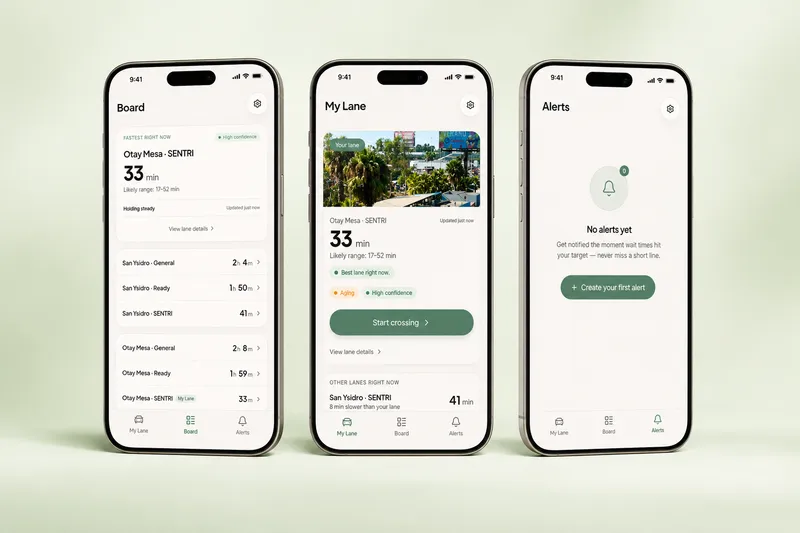
Which crossing, which lane, when to leave.
A border-wait planning product for northbound San Ysidro and Otay Mesa crossings. The public material currently covers the mobile planning experience; service and operator surfaces remain private.
Approved public screenshots and App Store and Google Play links are available.
Read case study brief · what i owned · key decisions · what was delivered · evidence · implementation
The problem
Border waits are not one number: travelers choose between crossings and lane types while the signal changes. Existing status checks make that comparison difficult to understand and harder to act on.
What I owned
- Product engineering for the mobile workflows shown here: saved lanes, crossing and lane comparison, target alerts, crossing start, and commuter preferences.
Key decisions
- Compare every supported crossing and lane in one board instead of making travelers inspect them separately.
- Expose a likely range, confidence, freshness, and trend alongside the estimate rather than presenting a naked wait number.
- Turn monitoring into an actionable workflow through saved lanes, target alerts, crossing start, quiet hours, and optional GPS assistance.
What was delivered
- Presents planning guidance alongside a likely range, confidence, freshness, and trend.
- Combines saved-lane status, six-way lane comparison, target alerts, crossing start, quiet hours, GPS assistance, and language preferences.
Evidence
- Approved public product captures show the My Lane, lane-comparison Board, Alerts, and Settings workflows.
- The Board visibly compares General, Ready, and SENTRI lanes at both supported crossings and identifies the fastest current option.
- Settings demonstrate primary-lane preferences, notification controls, quiet hours, GPS assistance, and English/Spanish selection.
Implementation
- Expo
- Fastify
- Next.js
- Postgres
- TypeScript